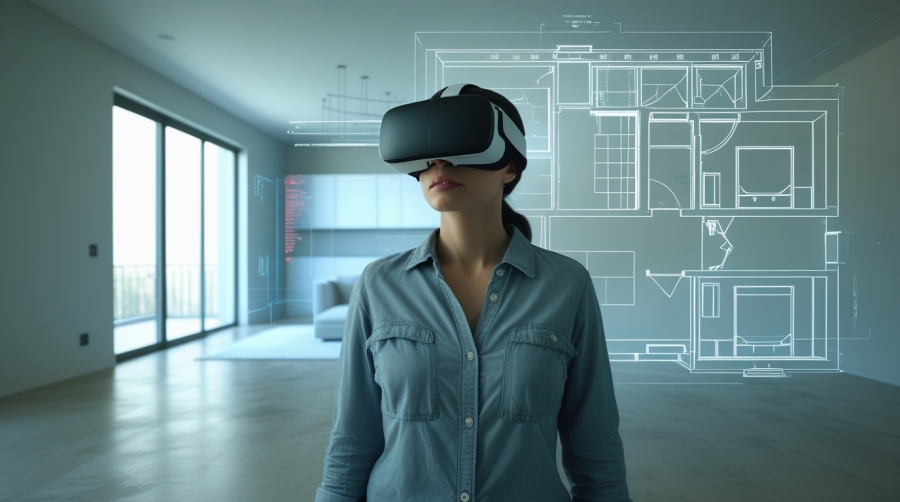
It begins not with a handshake at a front door, nor the creak of a staircase beneath cautious footsteps, but with a headset. A blink. A tilt of the head. And suddenly, you're no longer where you were.
Virtual reality, once the stuff of speculative fiction and gaming circles, has quietly slipped into real estate’s bloodstream. What was once a grainy slideshow or a passive YouTube video now becomes an experience you can step into. Literally. Or almost literally. In this shifting paradigm, buyers are no longer beholden to distance or time, and the homes? They come to you.
The shift is not cosmetic. It is structural. It changes everything.
The Emergence of the Walkthrough That Isn't
Photographs, no matter how well-lit, lie. They compress space, obscure flaws, and often evoke a sense of place that vanishes the moment you step into the real room. Videos help, to some extent. But even the slickest camera pans fall short of giving a buyer the agency to explore at their own pace. What if you want to turn left instead of right? Zoom in on that corner? Pause beneath that skylight and simply look up?
This is where virtual reality asserts its power. It transforms the act of looking into an act of moving, and in doing so, rewrites what it means to “visit” a home. Buyers don’t just see the house. They walk through it. They linger. They open digital doors, pivot in digital hallways, and imagine, often more vividly than any staged open house could allow.
For those searching from distant cities or entirely different countries, the convenience is transformative. Relocation no longer needs to be preceded by a harried week of travel and back-to-back appointments. VR dissolves geography. For these buyers, it's not just a tool. It's liberation.
Seeing, Feeling, Deciding
VR isn’t just flash. It’s tactile clarity. It gives depth to dimensions, and movement to imagination.
You can measure whether your dining table will fit beneath the window. You can sense if the open floor plan feels inviting or cavernous. You can question, in real time, the flow from kitchen to living room. That subtle interplay of space and function, so critical in real estate, is suddenly made visible in a way no blueprint ever managed.
And when VR combines with virtual staging, an empty house transforms. What once looked cold and bare can now be previewed in fully furnished versions, often tailored to suit various aesthetic tastes — modern minimalism, boho eclectic, classic mid-century. With a click, the sterile becomes warm. The abstract becomes personal.
Buyers are no longer asked to “imagine it.” They are shown.
Where the Edges Begin to Blur
But let’s pause before the enthusiasm gets too heady. The shine of a virtual walk-through is not without its shadows.
First, accessibility. Not everyone owns a VR headset. Not everyone wants to. While some agencies have moved toward web-based 3D tours viewable on desktops and mobile devices, the immersive richness of full VR still requires specialized hardware — headsets that are neither universally available nor particularly affordable.
And then there’s the human element. Virtual tours, as compelling as they may be, cannot transmit ambient noise. They don’t let you hear the dogs barking next door or the rumble of traffic just beyond the hedges. Nor can they replicate the feeling of sunlight falling across your skin at 3 p.m. on the patio. No headset can simulate the visceral truth of smell — damp carpeting, fresh paint, the hint of mildew in a seldom-used closet.
Technical difficulties compound the problem. VR relies on strong internet connections, advanced cameras, and well-rendered mapping. In regions with weaker infrastructure, VR becomes a luxury. A glitchy tour does more damage than no tour at all. And let us not ignore the physical discomfort some users face. Virtual reality sickness is real, and for a small but meaningful subset of the population, it makes these tours inaccessible altogether.
Agents in the Age of Immersion
For real estate professionals, this evolution demands more than just curiosity. It requires skill, adaptability, and an understanding that technology cannot replace intuition, but must work in tandem with it.
Agents are no longer merely hosts. They become curators, tech troubleshooters, sometimes even narrators. The best among them understand that a tour, no matter how immersive, cannot answer every question. Buyers still need context, reassurance, and real-time interaction.
Supplementing VR experiences with live virtual walk-throughs, conducted over video calls, allows agents to fill in the blanks — describing how morning light spills across the countertops, explaining neighborhood quirks, answering hyper-specific concerns about the slope of the driveway or the age of the water heater.
It’s not about eliminating the agent. It’s about evolving their role into something more nuanced.
Where the Future May Lead
What VR is today is not what it will be tomorrow.
As software becomes more refined and hardware more affordable, the threshold for entry will drop. More buyers will expect VR as a baseline, not a bonus. Eventually, augmented reality may blur further boundaries, allowing potential buyers to superimpose virtual homes onto empty lots, or simulate renovations before a sale has even closed.
But the speed of adoption will depend on more than just tech innovation. It hinges on trust, on access, and on ensuring that the benefits of immersive viewing don’t leave behind those without the devices or digital literacy to navigate them.
The risk, as with many technological shifts, lies in uneven implementation. When some agents use VR merely as novelty, the experience becomes gimmicky. When others lean too hard into the tech and forget the human behind the headset, it becomes alienating.
The Point Is Not to Impress. It Is to Understand.
Virtual reality is not here to replace the open house, but to reimagine it. To make it more inclusive. To allow the buyer in Paris to view a cottage in Cape Town without hopping on a plane. To empower the elderly couple who can’t drive across town. To give the busy parent juggling three jobs a real chance at homeownership by cutting through the fatigue of weekend showings.
VR is not magic. But when used with care, it feels like it.
In a world increasingly divided by distance and demand, virtual tours bring us a little closer to something rare in modern real estate — the ability to see clearly, choose wisely, and move confidently into spaces that, though once distant, now feel within reach.
So, no, it doesn’t begin with a handshake at a front door. It begins with a headset, yes. But perhaps, if we do this right, it still ends the same way — with keys in hand, and a door that opens.