




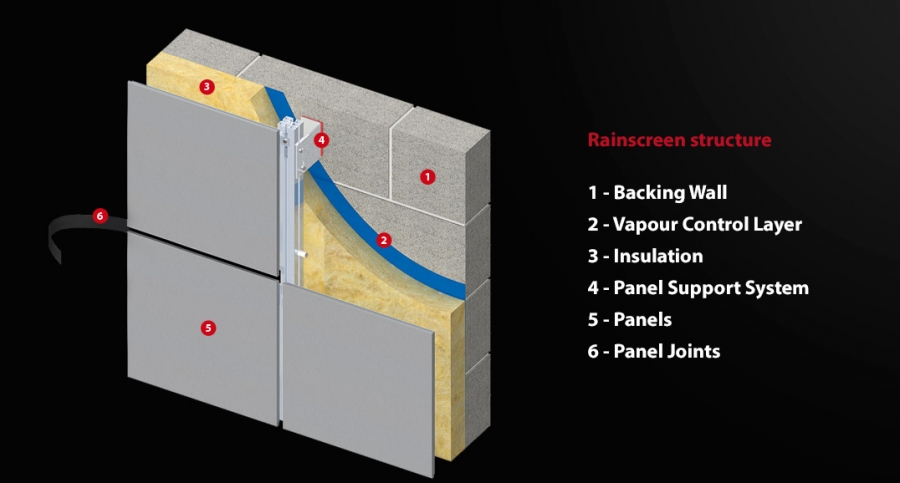

We are Proteus from the UK (www.kmearchitectural.com) and we are exporting more and more products overseas including to parts of the USA. We are specialist rainscreen cladding designers and manufacturers. We've put together some basic information below to familiarize our US market with how best to use rainscreen cladding in their real estate and building projects.
The purpose of rainscreens would be to bring some protection for external walls and to protect the building from rain as well as other climatic conditions. It diverts the rainwater in a different direction and as such saves the building from moisture related problems. Cladding means the procedure for covering one material with another. Usually, the top of the material that will get covered has already been finished as well - the cladding offers a protective coating. By providing a layer to drive the water away from the surface that needs protectio, the roof or external walls of any building are sheltered.

Cladding for rainscreens can be produced from wood, glass and stone masonry or metal. Cladding decreases the force that rain strikes the protected surface, as the cavity at its back would go to decrease the thrust of rainwater spanning a support wall.
Generally, the cladding features a porous nature and has vents within, facilitating the air flow towards the cavity and therefore preventing the moisture from getting developed within the cavity. Additionally, an airtight supporting wall, using its covering of the rigid coating of waterproof material, makes sure that moisture doesn't cause any injury to the dwelling.
Rainscreens can basically be classified into two classes:
Simple rainscreens
Pressure-equalized rainscreens.
The previous variety is normally sufficient for areas experiencing low rainfall. The cladding of the simple rainscreen is vented, as the support wall, engrossed in a water-proof material, is airtight. The lower wall often features a drain. An average illustration of this type of rainscreen will be a brick masonry finish over a concrete wall.
Structures in areas that have heavy rainfalls would be best paid by more complex pressure-equalized rainscreen. , as a rainstorm hits the building, the vents within the cladding enable the air contained in the cavity to bang against the layer of air barrier of the support wall,. That's the principle at work in their case. The moisture is prevented from entering the structure, because of the balancing of the outer and the inner pressure.
This balancing of two pressures works better in theory than in practice, however. However it helps a great deal to compartmentalize the cavity. To help avoid the rainwater from piercing with the cladding, the sizing of joints delivers excellent results. To get the greatest results, it is crucial to use quality sealants, as well as drainage layers on the support walls to make sure that the stress balancing system works efficiently.
It really is quite important to provide buildings with rainscreens, that help maintaining your external walls strong for a long period, as well as save the nuisance of frequent repairs from the building. Since rainscreens avoid the decay of the building because of moisture, they assist making the property a more secure spot to live and work.
To find out more please visit our page at www.kmearchitectural.com/technical/rainscreen/ - remember we serve the US market too.