




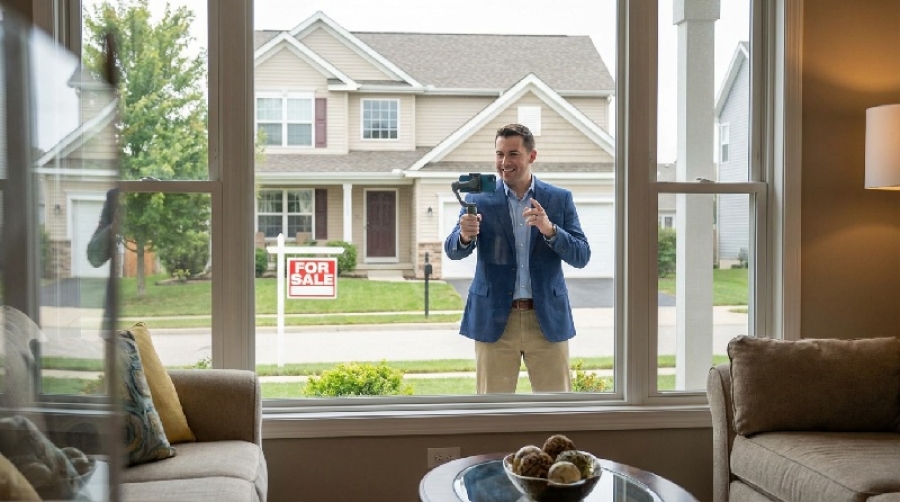
The photos were good. You know they were good because you paid for them, reviewed them, and approved them before the listing went live. And the listing still didn't move the way you expected it to.
This is one of the more frustrating experiences in real estate, and it's becoming more common. Not because photography quality has declined — it hasn't — but because the bar for what stops a buyer mid-scroll has risen. A well-lit kitchen is table stakes. Video is what creates the pause.
The catch: video production takes time and costs money that the math doesn't always support, particularly on mid-range listings, on waterfront properties that are hard to schedule around weather, on boat slips and rural lots and listings where getting a crew on-site is its own logistical problem.
AI has a direct answer to that catch. And agents who've started using it are finding that the gap between listings with AI-generated video and those without is showing up in inquiry volume.
Why video outperforms photos every time
Photographs require buyers to do interpretive work. They see a room and mentally assemble a sense of the space from static frames. They read the square footage and try to reconcile it with what they're looking at. They scroll past.
Video removes the interpretive requirement. A buyer watching a narrated property walkthrough doesn't have to imagine the flow of the layout — they experience it. The relationship between the dock and the house, the view from the master bedroom, the ceiling height in the main living space — these are communicated immediately, at a pace the buyer sets.
Listings with video consistently generate more inquiries and move faster than comparable listings without. This is well-established in real estate research and consistent with how buyers actually behave on the platforms where listings are discovered.
The production problem, and what changed
Traditional property video production involves scheduling, crew, editing, and delivery timelines that typically run two to three weeks from commission to a usable asset. During that time, the listing is sitting on the market without its most effective tool.
For a single-family home or a straightforward condo, the economics can work if the agent absorbs the cost or passes it to the seller. But for a $280,000 waterfront lot, a boat slip, a rental property, a rural parcel — commissioning traditional video production often doesn't pencil out.
Creatify AI changes that equation. It's an AI platform that generates narrated video presentations from a property listing URL, a set of images, or a written description. A photorealistic AI avatar — chosen from a library of over 1,500 digital presenters — delivers a scripted property walkthrough in any language, in any format, with delivery style and tone matched to the listing.
The process takes less than an hour. The cost per video is under $4.
What it looks like in practice
Paste the listing URL or upload your photos and property details. The AI script writer generates multiple script options based on the property's key features, neighborhood positioning, and buyer appeal. You select the approach that fits, choose an avatar that matches the tone of the listing, pick your format (9:16 for social, 16:9 for YouTube or your website), and render.
The result is a complete, narrated property video — not a slideshow with music, not a voiceover laid over photos. An actual presented walkthrough with a digital human delivering your property's story directly to the camera.
From there it goes directly to Instagram, TikTok, Facebook, or your own channels. Multiple format cuts — for Stories, for feed, for YouTube — come from the same session.
The listings where this matters most
The obvious application is any listing where traditional video production doesn't make economic sense but where the property would genuinely benefit from a presented walkthrough. That covers a lot of ground:
Waterfront and water-adjacent properties. Docks, boat slips, waterfront lots, lake houses, coastal properties — these are all listings where the relationship between the land and the water is the story. A narrated video that walks a buyer through that relationship, verbally and visually, communicates something that photos of a dock simply don't.
Rural and acreage listings. Buyers evaluating rural property are often doing it from a distance. They can't drive by. They can't get a feel for the land from a few photos. A video that describes the topography, the access, the potential — narrated by a professional-sounding presenter — holds attention in a way a static listing won't.
Investment properties. Cap rate, cash flow, tenant situation, renovation potential. These are conversations, not images. An AI-narrated video can walk an investor through the numbers and the opportunity in two minutes.
Listings at the early stage. There's a window at the start of every listing's market life when buyer attention is highest. Traditional production often misses that window. AI-generated video doesn't — it's ready before the listing is twenty-four hours old.
Multilingual markets. If your market includes buyers whose primary language isn't English — and most coastal and metropolitan markets do — AI video makes multilingual property presentation practical for the first time. The same listing generates an English version, a Spanish version, a Mandarin version from the same session. Without scheduling interpreters or additional production runs.
What agents are actually seeing
Zumper, a real estate platform serving over 76 million annual visitors annually, went from zero AI-generated property videos to over 300 in a single quarter after integrating this capability. The volume of video content that was previously logistically impossible became routine.
The pattern holds at the individual agent level. Properties with immediate, professional-quality video content generate more early inquiries. More early inquiries means more showing requests. More showing requests means faster movement and, in competitive situations, stronger negotiating position.
The cost of producing a complete AI-generated video suite for a listing — including social formats and multiple language cuts — is a rounding error compared to the commission on almost any transaction. The question isn't whether it's worth doing. The question is whether you get to it before your competition does.
The agents building the strongest positioning in AI-assisted property marketing aren't waiting for the technology to mature further. It's already mature enough to produce professional output, deploy across platforms, and cover listings at every price point. The window where early adoption is an advantage rather than a given is still open — but it won't stay open indefinitely.