




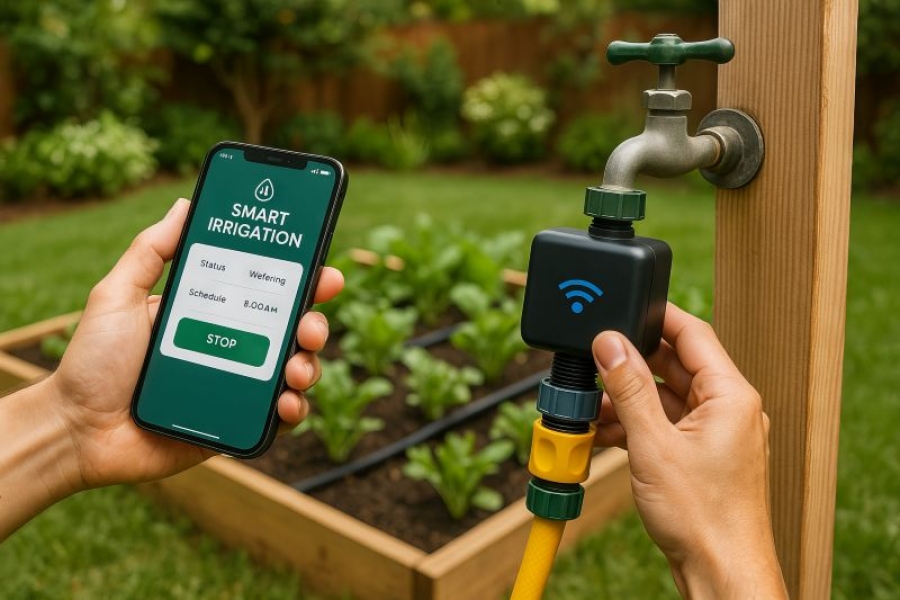
The smart home revolution has followed a predictable pattern over the past decade. First came thermostats that learned your schedule and saved energy costs. Then video doorbells that let you see visitors from anywhere. Smart locks, lighting systems, and voice assistants followed, each category transforming a previously manual home function into an automated, optimized system.
But there's been a conspicuous gap in this progression: water. While homeowners have enthusiastically adopted technologies that manage their heating, cooling, security, and lighting, outdoor water consumption, the single largest controllable expense on most utility bills, has remained stuck in the analog era. That's changing rapidly, and the implications extend far beyond convenience.
The smart water management market was valued at $18.2 billion in 2024 and is projected to grow to over $67 billion by 2035, reflecting annual growth rates exceeding 12%. Water rates have climbed 33% since 2010, significantly outpacing inflation. Landscape irrigation accounts for 30-50% of residential water consumption, and traditional systems waste approximately half of what they apply through poor coverage, evaporation, and overspray.
The convergence of rising costs, environmental consciousness, and mature IoT technology has created the conditions for smart water management to become the next major category in home automation.
Why Water Management Comes Last in the Smart Home
Smart thermostats succeeded first because they addressed an obvious pain point: heating and cooling costs represent the largest energy expense in most homes. The value proposition was immediate, install a Nest, watch your energy bills drop 10-20%, recover your investment within two years. Security devices followed a similar path with clear value and simple installation.
Water management presents more complex challenges. Unlike a single thermostat, outdoor irrigation involves multiple zones, dozens of spray heads, and significant coverage variation. The technology required isn't just connectivity, it's fundamental redesign of how water reaches landscaping.
Most homeowners don't realize how much they're wasting. Traditional irrigation runs on a timer set once and forgotten. The waste is invisible: water running onto driveways, overlap zones getting double coverage, evaporation during midday heat. You know your water bill is high, but the specific inefficiencies remain hidden.
The Technology Inflection Point
Multiple factors are converging to accelerate smart water adoption. The foundational technologies have become robust and affordable: universal WiFi, real-time cloud platforms, intuitive mobile apps, and long-life wireless sensors. This infrastructure maturity means smart water systems deliver the same seamless experience homeowners expect from other connected devices.
Regulatory pressure is accelerating adoption. Over 40 US metropolitan areas face water restrictions. California, Texas, Arizona, and other states offer rebates of $200-500 for high-efficiency systems. The economic case has fundamentally shifted: households now spend $500-800 annually on landscape irrigation, with drought-region costs exceeding $1,200-1,500. Systems cutting consumption 40-50% achieve payback in 3-5 years, matching smart thermostats.
Three Generations of Smart Water Technology
Smart irrigation has evolved through distinct technology generations, each addressing limitations of the previous while adding capabilities.
Weather-based controllers from Rachio, Rain Bird, and Orbit connect to local weather data and automatically adjust watering schedules. These systems deliver 20-30% water savings with installation costs of $150-400. The limitation lies in what they don't address: the underlying inefficiency of the sprinkler system itself. A weather-based controller might prevent watering during storms, but it can't fix overspray onto driveways or overlap zones receiving double the necessary water.
Soil moisture sensors added ground-truth measurement through sensors placed in the root zone. Leading implementations from Rain Bird, Hunter, and Toro deliver 30-40% water savings. Implementation costs run $300-600 for residential systems, with higher maintenance requirements for sensor cleaning and replacement.
Precision digital systems represent the frontier, reimagining the fundamental architecture. Rather than fixed mechanical zones, these systems treat each sprinkler head as a software-controlled instrument capable of creating custom coverage patterns.
Irrigreen exemplifies this approach, applying digital valve and nozzle technology adapted from precision printing patents. Instead of fixed spray arcs, Irrigreen's system uses app-based mapping to create exact coverage patterns matching property boundaries. A single head covers 2,000-2,800 square feet, equivalent to 15-20 traditional spray heads, eliminating the overlaps, gaps, and overspray inherent in zone-based designs.
Technical discussions from industry professionals and the engineering philosophy behind Irrigreen's digital systems represent a category shift from hardware-defined to software-defined irrigation. Water savings reach up to 50% compared to traditional systems. Installation costs of $2,500-3,500 position these systems as premium solutions justified primarily by new construction or full system replacement scenarios.
Industry analysis of smart home water trends demonstrates how software-defined control enables capabilities impossible with mechanical systems: adaptive coverage during lawn establishment, seasonal adjustment for dormancy cycles, and zone-specific watering for mixed landscaping.
The Smart Home Integration Advantage
Smart water management fits seamlessly into connected home ecosystems millions have already built. Homeowners with Nest thermostats, Ring doorbells, and Philips Hue lighting understand connected device value. The leap to smart irrigation is logical, not revolutionary.
This familiarity reduces adoption friction dramatically. Setup is familiar: download app, connect to WiFi. Integration with Google Home, Amazon Alexa, and Apple HomeKit enables voice control and automation alongside other systems. A smart platform knowing you're on vacation can pause irrigation automatically. Leak detection alerts arrive through the same channels as security notifications.
This explains why smart irrigation will likely accelerate faster than early thermostats. Nest convinced homeowners to buy their first connected device. Smart irrigation enters homes with 5-10 existing devices. The behavioral change is minimal, the value proposition immediately understood.
Real-World Performance Validation
Smart thermostats succeeded because adopters documented genuine 10-20% energy savings. Smart irrigation is reaching the same validation point with detailed Irrigreen homeowner assessments and community discussions about Irrigreen's smart irrigation technology providing year-over-year data, seasonal performance, and utility bill reductions.
Water consumption reductions of 45-52% appear achievable with precision digital systems. Lawn quality typically improves rather than degrades. Precision watering promotes deeper root development and eliminates brown spots and overwatered patches.
System costs of $2,500-3,500 with annual savings of $300-600 produce 3-5 year payback periods. Lifetime savings of $3,000-9,000 over 15-20 years position smart irrigation as rare home improvements generating positive returns while reducing environmental impact. Analysis of Irrigreen performance across climate zones confirms universal benefits similar to thermostat efficiency gains.
Beyond Irrigation: The Whole-Home Water Future
Smart irrigation is opening broader conversations about whole-home water management. Just as thermostats became hubs for comprehensive energy management, irrigation systems are evolving into platforms monitoring all residential water use.
Leak detection represents the immediate expansion opportunity. Advanced systems integrate sensors detecting unusual flow patterns throughout home plumbing. The EPA reports household leaks waste nearly one trillion gallons annually nationwide. Recent coverage of conservation initiatives highlights how the sector attracts both impact investors and traditional VCs seeing water efficiency as a growth market with strong economics and favorable regulatory tailwinds.
The Smart Water Moment Has Arrived
Smart water management has reached its inflection point. The pattern from thermostats and doorbells, skepticism giving way to rapid adoption once technology matures and economics favor it, is repeating.
For homeowners embracing smart homes, water is the logical next frontier. Economics match or exceed other smart investments. Technology has matured past early-adopter risks. Installation is straightforward, performance validated by real-world data, integration seamless.
Residential irrigation consumes 9 billion gallons daily across the United States. If smart systems captured 20% of this market delivering 40% savings, that represents 250 billion gallons saved annually.
The future of home water management is here, looking remarkably like the connected, optimized, automated systems already welcomed into every other part of your home.