Picture this: a Caribbean island where foreigners enjoy identical property rights as citizens, capital gains tax is zero, and the last hurricane made landfall in 1877. For realtors advising clients on international investments, Curaçao offers something rare—a genuinely compelling opportunity that doesn't come with the usual Caribbean complications. The Dutch-governed island has emerged as a serious contender in the international real estate market, and the numbers tell a story worth understanding.
A market that rewards careful research
Curaçao's real estate landscape spans an impressive range. According to current market data, approximately 800 homes and apartments are listed for sale with 45+ realtors at any given time, with prices stretching from roughly $107,000 to over $9 million USD. The median home price sits around $652,000 USD, though that average climbs to nearly $880,000 when factoring in luxury inventory.
What makes this market particularly interesting for real estate professionals is its segmentation. Around 45% of listings fall below XCG 1 million (approximately $560,000 USD), meaning there's genuine inventory for middle-market buyers—not just ultra-luxury trophy properties. The sweet spot for available homes falls in the $280,000 to $560,000 range, where inventory is deepest and negotiating room tends to be strongest.
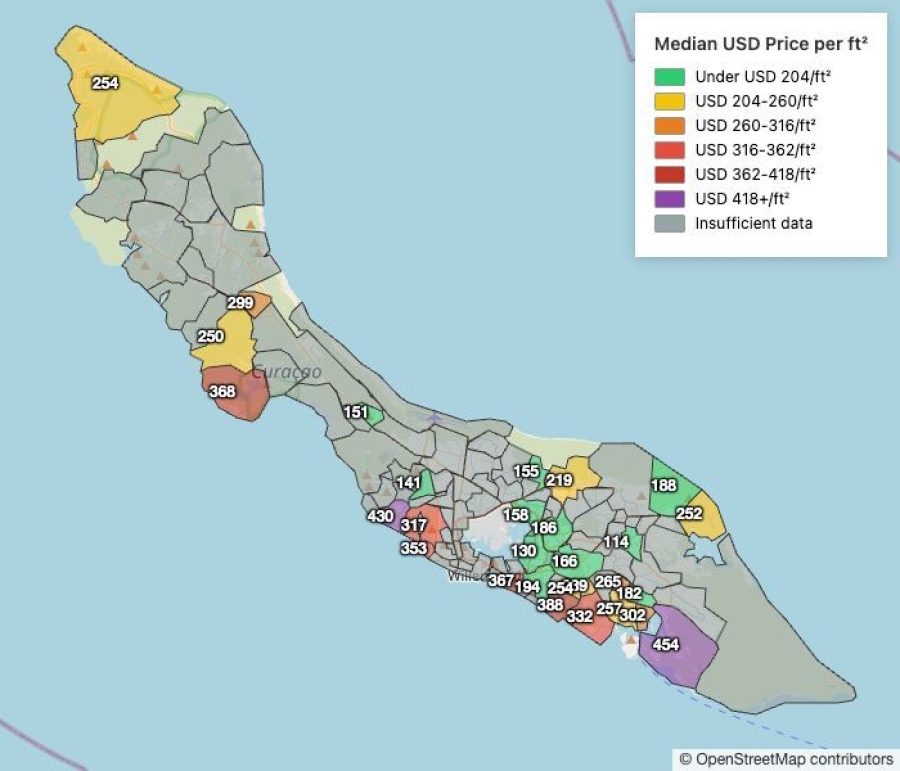
Per-square-meter pricing reveals the market's diversity. Budget-conscious buyers can find properties starting around $465/m², typically in rural areas like Barber or Santa Maria, though these often require renovation and may sit on leasehold land. At the premium end, waterfront villas in gated communities can command nearly $11,000/m²—a factor of 20 difference that speaks to the range of opportunities available.
What Realtors® should tell clients about buying here
The buying process in Curaçao follows Dutch civil law, which offers several advantages over other Caribbean jurisdictions. Property rights are clear and protected, backed by a notary system and the Kadaster (Land Registry) that provides ownership certainty. For clients accustomed to dealing with complicated foreign ownership rules elsewhere in the Caribbean, Caribbean House Hunt notes that Curaçao requires no alien landholding licenses, no special permits, and no government approval—foreign buyers enjoy identical rights to citizens.
Here's the typical timeline: After finding a property and making an offer, buyers sign a purchase agreement and receive a 3 full working days cooling-off period. They then place a 10% deposit into escrow with the notary. Due diligence—where the notary investigates title at the Kadaster—previously took 6-8 weeks but currently runs up to three months due to a shortage of notaries on the island. Both parties sign the transport act at the notary's office, final payment is made, and keys typically change hands immediately.
Total closing costs run 5-7% of the purchase price, breaking down as follows: 4% transfer tax, 1-2% in notary fees (plus surcharges), roughly $450 for land registry, and appraisal fees if a mortgage is involved. For comparison, many Caribbean islands charge 10-12.5% in alien landholding fees alone—a significant savings for foreign buyers choosing Curaçao.
The tax picture that gets clients' attention
Annual property taxes in Curaçao follow a tiered structure: 0.4% for properties valued up to NAf 350,000, 0.5% for the next tier up to NAf 750,000, and 0.6% above that threshold. Manageable numbers that won't surprise clients.
But the headline is capital gains: there isn't any. Appreciation on a private residence sale is entirely tax-free in Curaçao. For investors eyeing long-term appreciation in a growing market, this represents a meaningful advantage over many competing destinations.
U.S. clients will need to understand their reporting obligations. Worldwide income, including rental income, must be reported on Form 1040. However, direct real estate ownership is not considered a "specified foreign financial asset," so Form 8938 doesn't apply. The FBAR requirement kicks in only if foreign bank accounts exceed $10,000 total. Curaçao banking has been FATCA-compliant since 2014, so there shouldn't be complications on that front.
Financing options for residents and foreign buyers
Current mortgage rates in Curaçao range from 4.5% to 6%, with some promotional rates dipping as low as 4.49%. Local banks including Maduro & Curiel's Bank, Banco di Caribe, RBC Royal Bank, and Orco Bank all offer mortgage products.
For residents, banks typically finance 70-80% of market value with 20-30% down, on terms up to 30 years. Non-residents face steeper requirements: 35-40% down payment depending on the lender. RBC Royal Bank requires 35% minimum while Banco di Caribe asks for 40%. Realtors should counsel foreign buyers to come prepared with larger equity positions.
The Caribbean Guilder maintains a fixed peg to the U.S. dollar at 1 USD = 1.78 XCG, eliminating currency risk for American investors. It's one less variable to worry about in an international transaction.
Where the action is happening
Several neighborhoods dominate the market in terms of inventory and buyer interest. Coral Estate leads with 105 active listings—a 900-acre gated community on the west side with only 30% developed, suggesting continued growth. Jan Thiel follows with 98 listings, popular for its beach lifestyle and community amenities. Blue Bay offers 83 listings with resort-style living and beach access.
The Spanish Water area combines nearly 200 listings across multiple communities, featuring stunning waterfront properties. For buyers seeking upmarket locations at relatively better value, Brakkeput offers the best deal in the Spanish Water vicinity at approximately XCG 4,950/m², while Emmastad delivers great value for a central location at roughly XCG 3,048/m².
At the premium end, Santa Barbara commands the highest prices—nearly XCG 6 million median—and represents the most exclusive address on the east coast. Budget-conscious buyers should look at areas like Kwarchi (roughly $53,000/bedroom) or St. Catharina (approximately $110,000/bedroom) for more accessible entry points.
Pool availability tells its own story about market segmentation. Below the $560,000 mark, about 60% of properties include pool access, often shared. Above that threshold, 80-90% feature pools, typically private. One notable listing includes a villa with four swimming pools—another boasts an indoor pool in Soto.
The tourism factor driving rental yields
For clients interested in vacation rental income, the numbers deserve attention. Curaçao welcomed over 1.1 million visitors in the first eight months of 2025, up nearly 14% year-over-year. Hotel occupancy runs 73-79%, while vacation rental occupancy ranges 65-83%.
The result? Vacation rental yields are approaching 14% annually—a compelling figure that's driving investor interest. Combined with zero capital gains tax and the appreciation potential in a growing market, the investment thesis writes itself.
One critical detail about working with Curaçao Realtors
Real estate professionals should know that Curaçao has no formal licensing requirements for real estate agents. Anyone can present themselves as a realtor. Commission typically runs 4%, paid by the seller rather than the buyer. Major international brands like RE/MAX BonBini and Keller Williams operate on the island alongside local agencies.
This lack of regulation for realtors makes due diligence on agent selection important. For clients beginning their search, Caribbeanhousehunt.com aggregates over 1,500 listings from 45+ Curaçao realtor websites across the island, updated daily, providing a useful starting point for understanding what's available and at what price points. In their Market Overview Report there is also a list of all realtors on the island with their respective numbers.
The climate advantage that's easy to overlook
Beyond the investment fundamentals, Curaçao offers something clients will appreciate: stability. The island lies outside the hurricane belt—the last hurricane to directly hit was September 23, 1877, over 140 years ago. Average temperatures hover around 27°C (81°F) year-round, with trade winds providing natural cooling. The sea is never far away on this compact island.
Willemstad's historic center holds UNESCO World Heritage status since 1997, with 743 listed monuments showcasing Dutch colonial architecture. The Pietermaai district has transformed into what locals call the "SoHo of Curaçao," featuring boutique hotels and vibrant nightlife.
For realtors serving clients seeking Caribbean property without hurricane anxiety, Dutch legal protections, zero capital gains tax, and genuine rental income potential, Curaçao deserves a place on the shortlist. The market isn't without complexity—that notary shortage is real, and buyers need realistic timelines—but the fundamentals tell a story worth sharing.