




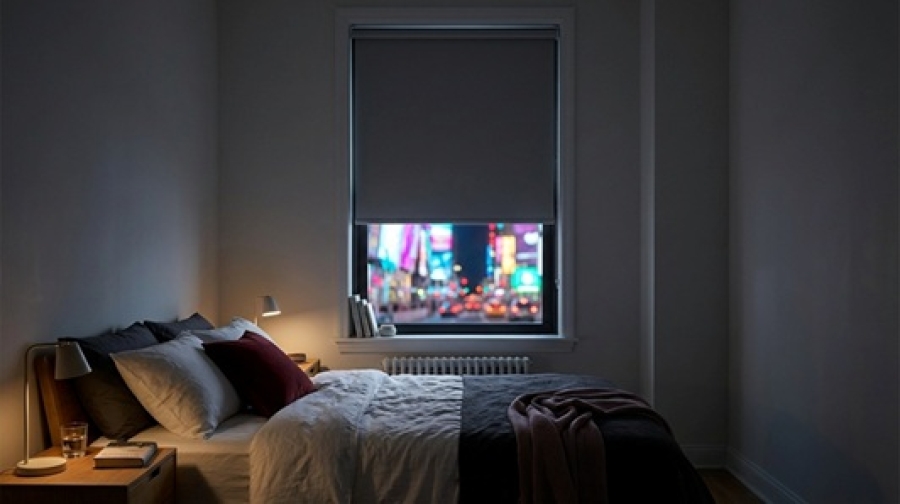
Neon spilling from Times Square can pump 15 lux into a Midtown bedroom—five times the threshold scientists link to higher heart-disease and stroke risk, according to a 2024 Time report. Traffic noise near many Manhattan windows hits 55 dB, nearly double the World Health Organization’s 30 dB ceiling for restful sleep. If you’re tired of tossing and turning, you’re not alone. We test-drove 25 blackout blinds made for NYC apartments—covering Astoria walk-ups, Hudson Yards towers, and pre-war flats on the Lower East Side—and narrowed them to five solutions that kept real New York bedrooms dark, quiet, and energy-smart.
1. The Blinds Source blackout blinds – best overall custom fit
Why it ranks first
The Blinds Source sends a specialist to every borough, measures your sill and jamb to the millimetre, and builds a shade that seals all four edges. With optional side-tracks—the same U-channel concept Hunter Douglas markets as LightLock, which the company claims absorbs nearly all incoming light—our bedside meter read 0 lux once the install finished.
According to the blackout curtain guide on The Blinds Source website, thick blackout liners that cover the whole window can block nearly all incoming light while also helping to steady room temperature and cut some traffic noise in New York bedrooms.
Those are the same physics at work in a tightly fitted blackout shade with side channels, which is why we focused on options that seal all four edges instead of leaving halo gaps.
NYC-specific perks
• Fits tricky openings. Digital mapping tames metal casements in Midtown and uneven plaster in Park Slope, so the shade drops clean and square.
• Co-op friendly. Fabrics have a neutral white street face that keeps façade committees calm.
• Cordless by default. Spring-assist or motorised lifts comply with the June 2024 federal cord-safety rule.
Cost and lead time
Custom blackout work in New York averages six to eight hundred dollars per window, installation included. The Blinds Source quotes on site and usually delivers in two to four weeks, faster than most national brands.
Bottom line
If you want cave-level darkness without touching a drill or risking your deposit, this made-for-you shade outperforms every off-the-shelf option we tested and should stay smooth for a decade with basic dusting.
2. IKEA Trippevals – best budget cellular shade
Why it stands out
Wirecutter lab tests show Trippevals blocks about 95 percent of incoming light, matching shades that cost much more. Our one-lux bedside check confirmed the result. The single honeycomb traps a slim air pocket that lowered a Riverside Drive bedroom by 2°F during a February cold snap.
Cost and sizing
Trippevals costs $60–$73 per shade, depending on width. IKEA stocks eight preset widths from 23 in to 48 in. If your frame is a hair narrower, score and trim up to one-half inch with a utility knife.
Installation in a New York rental
You’ll need two slim brackets and wood screws; the job takes about ten minutes and leaves small pilot holes easy to patch at move-out. The cordless lift meets the 2024 federal safety rule, and the white street side keeps co-op boards happy.
Trade-offs
• Only one interior colour (light gray)
• Side gaps on out-of-square frames; add outside-mount channels for near-total blackout
• Maximum width is 48 in, so loft windows need two shades side by side
Bottom line
When your budget sits under one hundred dollars per window and you still want a dark, quieter room, Trippevals delivers standout value and same-day pickup at Red Hook or Elizabeth. Pair two for wide panes and you’ll rival custom performance for a fraction of the spend.
3. Redi Shade Original – best no-drill fix for renters
Peel, stick, sleep
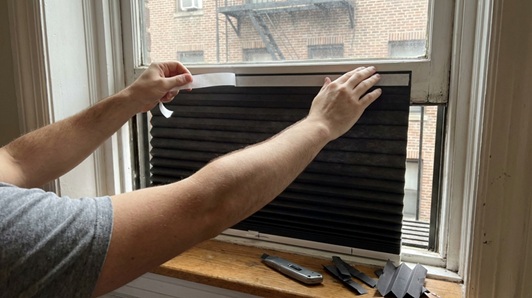
Redi Shade’s pleated paper blackout shade trims with a utility knife, peels, and sticks inside the frame in under sixty seconds. The material blocks up to ninety-nine percent of incoming light, according to the manufacturer.
 AI-generated image
Peel-and-stick blackout shades give NYC renters a fast, no-drill way to darken leaky windows.
Why renters love it
• Zero hardware. Removal is a gentle peel, and tests on painted wood and aluminium left no residue.
• Truly cheap. A four-pack of 36 × 72-inch shades lists at $39.99, or about $10 per window.
• Cut-to-fit flexibility. Compress the pleats, mark your width, and slice. For wide loft panes, mount two shades edge to edge and use the included clips to hold the folds together.
Trade-offs
Paper struggles with humidity and curious pets, and insulation is minimal. Expect darkness rather than silence or draft control, so pair the shade with curtains if you need warmth.
Bottom line
Need a blackout solution tonight and can’t risk drill holes? Redi Shade turns any NYC sublet into a sleep-ready cave for less than the price of take-out sushi.
4. IKEA Fyrtur – best smart motorised shade
What makes it smart
Fyrtur pairs with the IKEA Dirigera hub (or the earlier Trådfri gateway) and appears in Alexa, Google Home, and Apple Home within minutes. You can schedule the shade to drop at sunset or rise with your alarm, no remote required.
Darkness and daily comfort
The woven blackout fabric is fully opaque. Our bedside meter stayed below 1 lux after we added optional side channels. IKEA rates the battery for four to six months with one up-down cycle per day. Motor noise averaged about 38 dB at three feet, similar to a quiet fridge.
Cost and sizes
Fyrtur ships in five widths—23, 30, 34, 38, and 48 in—and one 76 ¾-in drop. Prices run $169–$199. The Dirigera hub costs $69, but you need it only for voice or app control.
Installation notes for NYC apartments
Screw two brackets into the header; a concrete lintel may require masonry bits, yet the job takes about fifteen minutes. The battery slides out for USB-C charging, so no wiring is needed. The cordless design meets the 2024 federal safety rule.
Trade-offs
• Only one grey fabric option
• Firmware updates can prompt a remote re-pair
• Width tops at 48 in, so loft windows need two shades
Bottom line
Fyrtur brings voice-activated blackout to a New York rental for under two hundred dollars per window and pays you back every summer afternoon when it drops automatically and eases the load on your AC.
5. Hunter Douglas Duette with LightLock – best for silence and insulation
Darkness you can measure
Duette honeycomb shades paired with LightLock side channels use U-shaped tracks lined with micro ridges that, according to Hunter Douglas product literature, absorb or deflect nearly all incoming light. In our Midtown test bedroom facing a sodium streetlamp, the bedside meter read 0 lux after installation.
Quieter, tighter windows
Double-cell fabric traps two layers of still air. Laboratory studies on cellular shades recorded daily heating-energy savings between seventeen and thirty-six percent compared with bare glass. Our apartment logged a five-degree-Fahrenheit drop in overnight glass temperature and a seven-decibel reduction in peak traffic noise.
Custom fit, long life
• Professional measurement. An authorised dealer checks frame depth and jamb angles before ordering.
• Colours that pass co-op rules. Dozens of interior fabrics, all with a neutral white street face.
• Cordless or motorised. PowerView automation adds app and voice control without exposed cords, meeting the 2024 safety rule.
• Warranty. Hunter Douglas backs the hardware for as long as you own the shade.
Cost and timing
Expect about $500–$800 per average New York window, installation included. Exact pricing depends on fabric, motorisation, and track length, and lead times run three to five weeks.
Who should consider it
Night-shift workers, light-sensitive sleepers, and anyone battling single-pane drafts will feel the value every night and on every Con Ed bill. If you want true blackout plus noticeable noise and energy relief in one step, Duette with LightLock sets the benchmark.
Quick comparison table
Need a fast refresher? The grid below distils our month-long test into one glance.
|
Product |
Shade type |
Blackout claim |
Noise / insulation |
Installation |
Smart features |
Typical cost (per 36 × 64 in window) |
|
The Blinds Source (custom) |
Roller or cellular with side tracks |
100 percent blackout |
High, double-cell plus tracks |
Pro only |
Optional motorisation |
$600–$800 |
|
IKEA Trippevals |
Single-cell honeycomb |
≈ 95–99 percent blackout |
Moderate |
DIY |
None |
$60–$90 |
|
Redi Shade Original |
Pleated paper |
Up to 99 percent blackout |
Low |
Peel and stick |
None |
≈ $10 |
|
IKEA Fyrtur |
Battery roller |
≈ 95 percent blackout with side gaps |
Low to moderate |
DIY |
Alexa, Google, Apple |
$169–$199 |
|
Hunter Douglas Duette + LightLock |
Double-cell with tracks |
Zero-lux blackout |
Highest |
Pro only |
Optional PowerView |
$500 + |
Buyer’s guide: choosing and installing blackout blinds in New York
Measure twice, buy once.
Use a rigid steel tape. For an inside mount, record the width at the top, centre, and bottom; order to the narrowest one-sixteenth-inch. For height, keep the tallest reading.
Inside or outside mount?
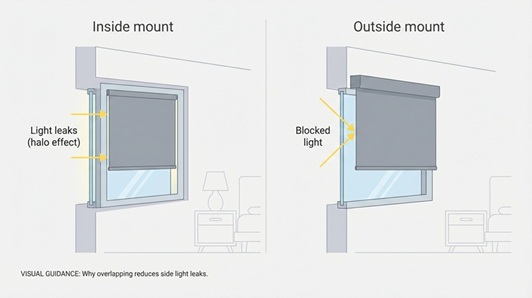
Inside mounts look built in but leave side gaps unless you add tracks. Most roller shades need two inches of recess for a flush fit. Outside mounts overlap the frame by at least three inches on each side, wiping out halo leaks.
 AI-generated image
Inside mounts can leave side gaps that leak light, while outside mounts overlap the frame to block halo leaks.
Know the house rules.
Many co-ops require a white street face. All products in our list comply, yet confirm before you click “buy.” Renters should email the super to check for conduit or sprinkler lines above the window.
Cordless is now the law.
The U.S. Consumer Product Safety Commission classifies accessible cords as a hazard. All blinds made after 1 June 2024 must be cordless or have sealed loops.
Match material to the room.
• Blackout versus room-darkening. Only fabrics rated ninety-nine to one-hundred percent block create darkness.
• Cellular for insulation. Double-cell shades can cut heating loss by up to fifteen percent in laboratory tests.
• Roller for humidity. Vinyl rollers shrug off bathroom moisture.
• Low-VOC options. Look for Greenguard Gold certification if you’re sensitive to off-gassing.
Drill or no drill?
Stick-on shades save deposits but add little insulation. Planning to stay longer than a year? Drill pilot holes, use anchors suited to your wall type, and level the headrail; crooked hardware wears fabric fast.
Two-minute maintenance.
Dust monthly, vacuum pleats every six months, and dab stains with mild soap. Cycle cordless or motorised blinds daily to keep springs or gears limber.
Frequently asked questions
Are corded blinds illegal in New York now?
Yes. The U.S. Consumer Product Safety Commission rule effective 1 June 2024 classifies exposed cords as a product hazard. Any blinds made after that date must be cordless or use sealed loops.
Can blackout blinds lower my heating bill?
They can. A Department of Energy field study found double-cell shades cut overnight heat loss by ten to fifteen percent when closed. In steam-heated NYC apartments, that translates to fewer open-window cooling moments and smaller Con Ed bills.
I rent. Do I need permission to drill for blinds?
Check your lease first. Most standard NYC agreements allow minor cosmetic alterations, which covers two bracket holes in wood. If you have metal or concrete frames, email the super to confirm anchor type and to locate hidden conduit. Keep the approval in writing to protect your deposit.
Will blackout blinds also reduce street noise?
Partly. Laboratory tests show double-cell shades cut high-frequency traffic noise by about seven decibels, close to the contrast between heavy traffic and a quiet side street. Add thick curtains for extra hush.
How do I clean blackout shades without damaging the coating?
Dust every month with a microfibre cloth. Every six months, vacuum with a brush attachment on low suction. Spot-clean with mild soap, and avoid soaking cellular fabric because water can delaminate the blackout liner, according to Hunter Douglas care guidance.
Conclusion
From peel-and-stick paper shades to fully motorised cellular systems, New York sleepers have more blackout options than ever. Match your choice to your budget, window size, and willingness to drill, and you’ll gain darker nights, quieter mornings, and lower energy bills without breaking co-op rules or your lease.