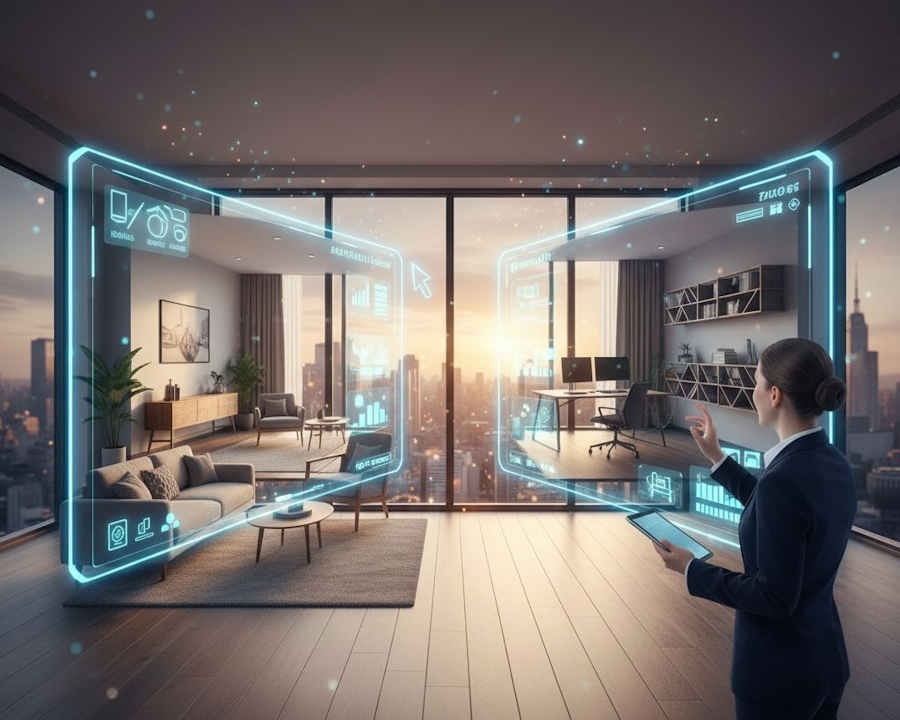
In real estate, the empty room is a silent deal-killer. It is spacious, yes, but it is also cold, echoing, and-for the vast majority of buyers-intellectually impenetrable. When a potential buyer walks into a vacant living room or scrolls past a hollowed-out master bedroom on Zillow, they aren't just seeing a lack of furniture; they are hitting a cognitive wall.
According to recent data from the National Association of Realtors (NAR), 82% of buyer's agents report that staging makes it easier for a buyer to visualize the property as a future home. This statistic reveals a fundamental truth about the human brain: we are not naturally wired to fill in the blanks. We struggle to calculate scale, we underestimate potential, and most critically, we fail to form an emotional connection with a void.
For decades, the industry's answer to this "imagination gap" was physical staging. It was effective, but logistically heavy-costing thousands of dollars and weeks of time. Then came the first wave of virtual staging: affordable, but often plagued by floating sofas, mismatched lighting, and a distinct "uncanny valley" feel that shouted "fake" to anyone paying attention.
Today, we are witnessing a third evolution. It is no longer about simply pasting a digital couch into a JPEG. It is about "empathy-driven" design. To bridge the gap between cold pixels and warm emotions, forward-thinking agents are turning to a new generation of AI virtual staging tool solutions that prioritize lighting, mood, and seamless workflow over mere object placement. This shift is not just changing how homes look online; it is fundamentally altering the speed at which real estate moves.
The Psychology of the "Imagination Gap"
To understand why the new wave of AI tools is necessary, we must first appreciate the psychological friction involved in buying a home. A home purchase is rarely a purely logical decision based on square footage and school districts. It is an emotional projection of a future self.
When a buyer views a property, they are subconsciously asking: Do I belong here?
In an empty space, the answer is often silence. The NAR's 2024 profile highlights that buyers are more willing to walk through a home they have seen staged online. Why? Because the staging did the cognitive heavy lifting for them. It provided a frame of reference for the scale of the room (e.g., "Oh, a king-size bed does fit there") and, more importantly, it set a mood.
However, the "imagination gap" is wider than many agents realize. Studies suggest that a significant portion of the population struggles with visualization-a spectrum ranging from weak visual imagery to aphantasia (the inability to visualize mental images at all). For these buyers, an empty photo is not a blank canvas; it is a dead end. They simply cannot hallucinate a renovation.
This is where the technology of 2025 diverges from the tools of 2020. The goal is no longer to deceive the eye but to guide the heart. Modern AI creates what we call "atmospheric context"-using light and shadow to suggest the time of day, the warmth of the season, and the rhythm of life in that space.
The Evolution: From "Furniture Stuffing" to Design Intelligence
For a long time, virtual staging was treated as a commodity-a box to be checked. Agents would send photos to a service, wait 24 to 48 hours, and receive images that looked "furnished" but rarely "designed."
The friction in this legacy model is undeniable. If the virtual sofa was the wrong style-say, a heavy Victorian loveseat in a mid-century modern living room-the agent had to request a revision, wait another day, and hope for the best. This back-and-forth loop killed momentum.
The new standard is defined by what product architects call "The Flow State."
In 2025, the most effective tools operate in real-time. They utilize a "Type → See → Tweak" loop. An agent can upload a photo of a vacant spare room, type "cozy reading nook, Scandinavian style, morning light," and generate a visualization instantly. If the rug is too dark, they don't send an email to a support desk; they simply click the rug and ask the AI to change it.
This shift from "ordering a render" to "collaborating with AI" allows agents to tailor the staging to the specific demographic of the listing. A downtown loft can be staged as a bachelor pad for one listing portal and a creative workspace for another, all within minutes. The technology has moved from static furniture stuffing to dynamic design intelligence.
Breaking the "Fake" Barrier: Realism and Commerce
One of the most persistent criticisms of virtual staging has been its disconnect from reality. In the early days, the 3D models used were generic assets-furniture that didn't exist in the real world, often scaled incorrectly. A chair might look like it was made for a giant, or a lamp might cast no shadow.
This lack of physical integrity breaks trust. If a buyer feels the image is "lying" about the furniture, they subconsciously wonder what else the listing is lying about.
The solution emerging now is the integration of real furniture catalogues into AI models. Platforms like Paintit.ai are leading this shift by connecting visualizations directly to purchasable inventory, ensuring that the 'mid-century modern chair' in the render is a real item the buyer can actually acquire
This brings two massive advantages:
1. Photorealism: Real furniture has real textures, wrinkles, and proportions. When AI places a real West Elm or IKEA chair, it calculates how light hits that specific fabric. The result is a "lived-in" look rather than a sterile 3D model.
2. Actionability: We are moving toward a "shop the look" reality. When a buyer falls in love with a virtually staged living room, the furniture is not a fiction-it is a shopping list. This moves the staging from a marketing gimmick to a service. The agent isn't just selling a house; they are selling a lifestyle that is immediately attainable.
The Economics of Staging in 2025
Ultimately, real estate is a numbers game. Agents and sellers must weigh the cost of marketing against the potential uplift in sale price.
Physical staging remains the gold standard for luxury properties where the in-person experience is paramount. However, its cost is prohibitive for the wider market. The median cost for a staging service is around $1,500, with comprehensive staging for larger homes easily exceeding $5,000. Furthermore, physical staging locks the property into a single aesthetic for the duration of the contract (usually 3 months).
Legacy virtual staging (manual editing) bridged the cost gap, averaging $30-$75 per photo. But for a whole house (10-15 photos), this still adds up to hundreds of dollars, and the "time cost" of 24-hour turnarounds remains high.
AI-driven workflow staging disrupts this cost structure entirely. By moving to subscription models (often under $30/month) or negligible per-image costs, agents can afford to stage every room, not just the "money shots."
Cost & Efficiency Comparison Table (2025 Estimates)
| Feature | Physical Staging | Legacy Virtual Staging | AI Flow Staging (2025) |
| Average Cost | $1,500 - $5,000+ | $30 - $75 per photo | Subscription ($15-$30/mo) |
| Turnaround Time | 7-14 Days | 24-48 Hours | Instant / Real-time |
| Flexibility | Low (Locked for months) | Medium (Revisions take days) | High (Iterate in seconds) |
| Reality Level | 100% (Tactile) | Varies (Often "uncanny") | High (Lighting-aware) |
| Best Use Case | Luxury / Open Houses | Key listing photos | Entire listings / Social / Testing styles |
The ROI: Why Speed Matters More Than Ever
The financial argument for staging is settled. Staged homes sell faster-up to 73% less time on the market according to some industry reports. They also sell for more, with 20% of agents observing value increases between 1% and 5%, and some data suggesting premiums of up to 15%.
But in 2025, the metric that matters most is speed to market.
In a volatile market where interest rates and inventory levels fluctuate weekly, waiting two weeks for a physical stager is a liability. Even waiting 48 hours for manual virtual staging can mean missing a weekend cycle on the major portals.
AI tools allow an agent to walk a property on Tuesday morning, snap photos with a smartphone, stage them in the car, and have the listing live and looking magazine-ready by Tuesday afternoon. This agility is a competitive moat. It signals to the seller that the agent is proactive, tech-savvy, and efficient.
Case Study: The "Unsellable" Spare Room
Consider the common scenario of the "undefined space." It is a 10x10 room with beige carpet and a single window. Is it a bedroom? A small office? A nursery? A gym?
In an empty photo, it is small and confusing. Physical staging forces the agent to choose one identity-usually a guest bedroom.
With AI staging, the agent does not have to choose. They can upload the same photo and generate three variations:
1. The WFH Professional: A sleek desk, ergonomic chair, and shelving.
2. The Young Family: A crib, soft rug, and warm lighting.
3. The Fitness Enthusiast: A yoga mat, mirrors, and plants.
These variations can be used in carousel ads on social media to target different buyer personas. This is "A/B testing" applied to home interiors, a strategy that was impossible with physical furniture and prohibitively expensive with legacy virtual staging.
Looking Ahead: AI as a Creative Partner
We are approaching a point where the term "virtual staging" might become obsolete, replaced by "digital interior design."
Future iterations of these tools will likely integrate even deeper with architectural data. We will see features that allow for "virtual renovation"-removing walls, changing flooring materials, or updating cabinetry-with the same ease as placing a sofa. This is crucial for selling "fixer-uppers" to buyers who lack the experience to see past the ugly wallpaper.
However, the core value remains empathy. The most successful agents in 2025 will not be the ones who use AI to churn out generic content, but the ones who use it to tell a specific story about a home. They will use these tools to answer the buyer's silent question: Can I be happy here?
By removing the friction of cost and time, AI empowers agents to focus on that narrative. It turns the daunting emptiness of a vacant property into a canvas of infinite potential. And in a market driven by first impressions, the ability to instantly fill a room with life is not just a technological trick-it is a sales necessity.