




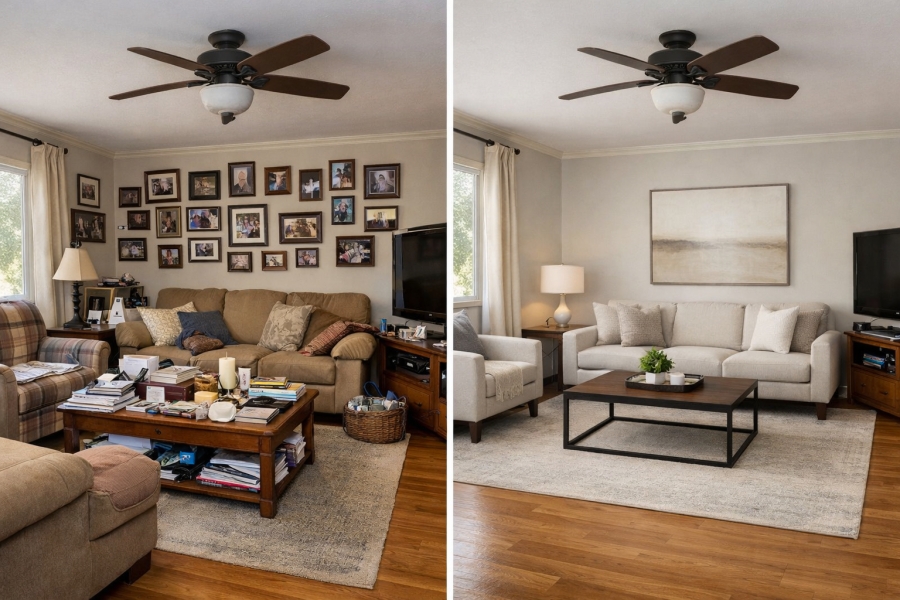
When a home doesn’t sell, the first assumption is usually price.
Sometimes that’s accurate. Often it isn’t.
More often, buyers are having trouble understanding the space.
Most buyers walk through a home quickly. They aren’t studying it. They’re checking whether the layout makes sense, whether the rooms feel usable, and whether anything immediately raises concern. Those judgments happen fast and they’re mostly visual.
If the space feels crowded, confusing, or darker than expected, buyers don’t stop to solve the problem. They just move on to the next house.
That’s where staging comes in.
Staging isn’t about decoration. It’s about making the layout and scale of a home clear to someone seeing it for the first time.
How buyers actually experience a home
Sellers live in the house. They know how each room functions.
Buyers don’t.
They don’t know which room was used as an office, which one is rarely used, or which corner “works fine once you live here.” They only see what’s physically there.
Furniture placement, scale, and quantity all affect how large or small a room feels. Too much furniture makes rooms feel tighter. Oversized pieces distort the sense of proportion. Items placed in walkways interrupt flow.
None of this is obvious to the seller because they’ve already adapted to the space.
To a buyer, it’s just information they have to process. And if there’s too much to process, they disengage.
Most staging work is removing, not adding
The biggest improvement usually comes from reducing what’s in the room.
Fewer pieces allow the room’s actual size to register. Clear surfaces help the eye move through the space. Consistent finishes prevent attention from jumping around.
The goal isn’t to make the room look styled. It’s to make it easy to read.
When a buyer can immediately tell where furniture fits, how light moves through the room, and how spaces connect, the home feels more straightforward. Straightforward homes feel lower effort. Lower effort homes get more serious consideration.
Why staging matters for photos
Most buyers decide whether to see a home based on photos.
If rooms appear tight, dark, or cluttered in photos, the listing loses attention quickly. Buyers don’t assume it looks better in person. They assume it’s similar to what they’re seeing.
Staging helps rooms photograph accurately. It prevents furniture from blocking windows, crowding walls, or overwhelming the frame. It allows lighting, layout, and finishes to show clearly.
In competitive markets, this matters. Listings are compared side by side. A home that reads clearly stands out without needing to look dramatic or overdone.
Staging doesn’t hide problems
Every home has limitations.
Staging doesn’t remove them. It keeps them from dominating the first impression.
When a buyer’s attention is immediately pulled toward clutter, awkward placement, or visual overload, the focus shifts away from the home itself. Once that happens, buyers start building a list of concerns, even if the issues are minor.
Staging keeps the focus where it belongs: on space, light, and layout.
What staging actually does for sellers
Staging doesn’t guarantee a sale.
It improves how the home is perceived.
It shortens the time it takes for a buyer to understand the space. It reduces uncertainty. It allows buyers to focus on whether the home fits their needs instead of trying to decode it.
That’s why staged homes often receive stronger interest. Not because they look impressive, but because they feel easier to say yes to.